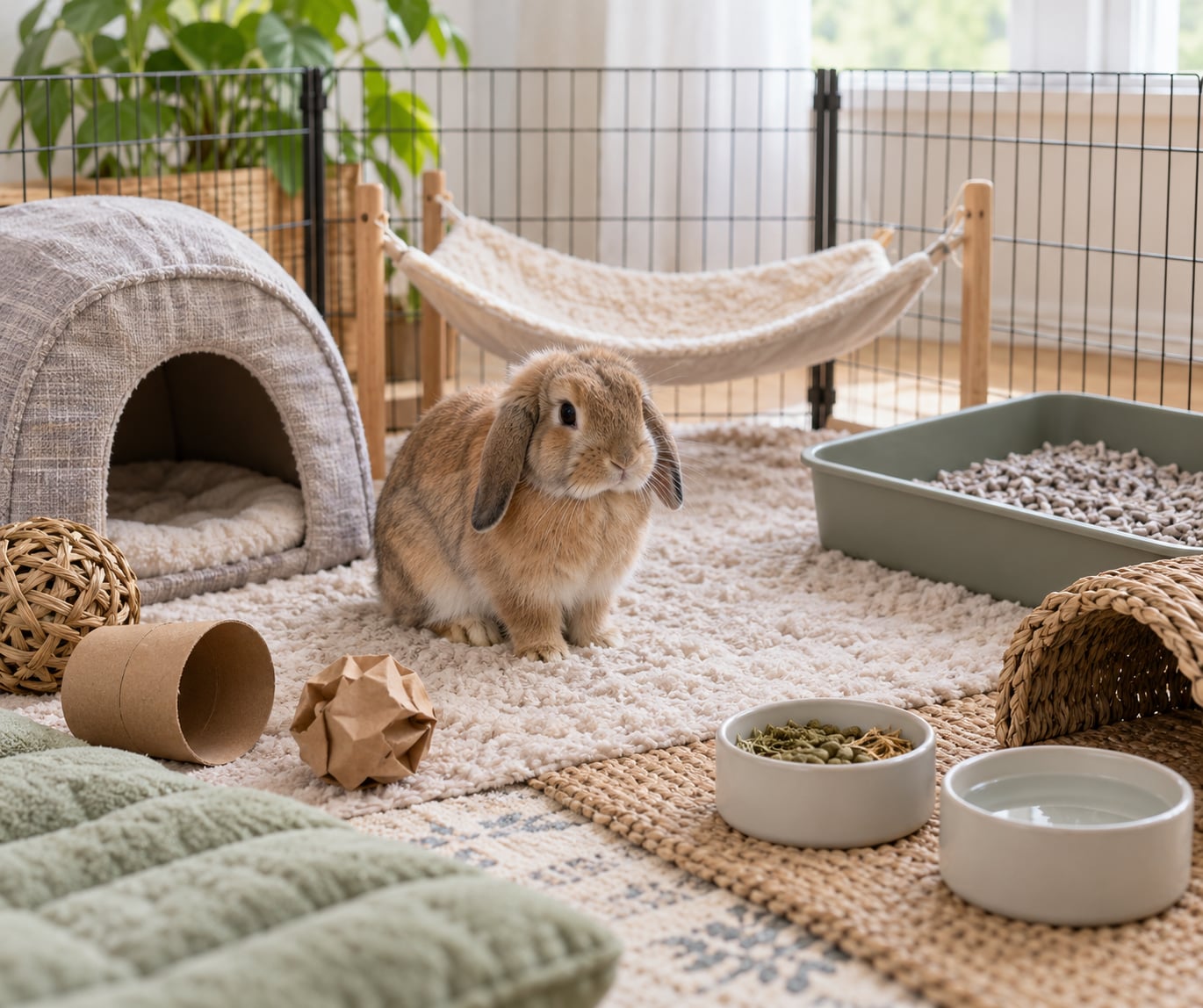
Learning how to litter train a ferret comes down to three things: a shallow, low-entry tray with a high back, plain unscented paper pellet litter, and a reward the second the ferret finishes in the right spot. Ferrets pick one bathroom corner instinctively, so the job is mostly about putting the tray where the animal already wants to go. Expect to spend two to four weeks before accidents become rare, and treat the first month as a daily routine rather than a one-off lesson.
Care and training are the same job, honestly. A ferret that is fed on schedule, exercised, and settled in a small predictable space toilets where you want it to. A ferret that’s stressed, over-stimulated, or suddenly ill does not, no matter how much you praise it.
The rest of this guide covers what to set up first, the step-by-step routine, the mistakes that slow progress, and when a toileting change means a call to the vet.
Table of Contents
What You Need
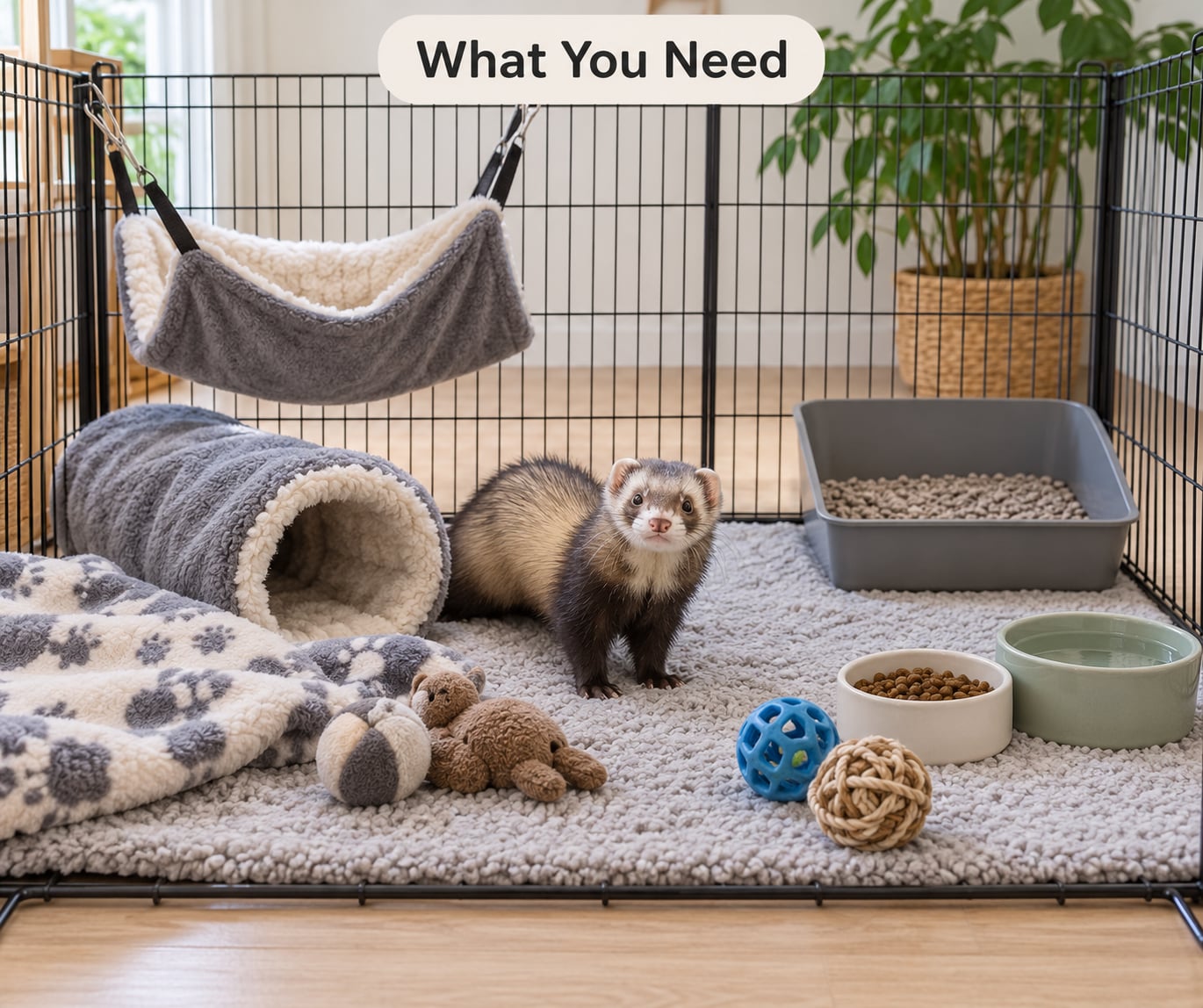
Before the ferret arrives, buy the setup. Owners who gather everything first avoid the most common early mistake, which is improvising with a bathroom sink and a shoe box while the animal waits.
Enclosure. A wire exercise pen or a wire cage with narrow bar spacing, roughly one inch, so the animal cannot squeeze its head through and get stuck. Bigger is better, and a playpen that gives a couple of square feet of floor space beats a tall narrow cage every time. Ferrets climb, but they also need somewhere to stretch out flat.
Bedding and hiding places. A couple of inches of soft paper bedding on the floor, plus at least one enclosed hideout. A fabric hammock suspended low in the pen works well. Without a place to disappear, a young ferret stays stressed and that stress shows up as toileting problems.
Food and water. Heavy, tip-resistant ceramic or metal bowls rather than light plastic ones, and an untippable water bottle mounted on the bars. A second water bowl is a reasonable backup for a hot week.
Litter system. One or more shallow trays with a high back wall and a low front lip, with a non-slip base so a ferret pushing in with its hind end cannot slide the whole thing across the floor. Open-top or low-sided boxes work better than enclosed hooded ones, because a ferret needs to back into the corner and get its rear end low.
Safe litter. Unscented, low-dust, non-clumping paper pellets, filled to less than an inch deep. Avoid clay, clumping cat litter, scented varieties, silica or crystal litter, corn cob, and pine or cedar shavings. Ferrets dig their nose straight into the substrate and inhale a lot of dust, and clumping litter is a genuine ingestion and obstruction risk if any gets swallowed.
Grooming and play supplies. A small animal brush, cat nail clippers, and a few safe toys such as paper bags, cardboard tubes, or crinkly fabric tunnels with no loose parts or dangling strings. Skip anything with small detachable pieces.
Step-by-Step
Step 1: Prepare a Safe Ferret Home
Set up the whole space before the ferret explores it, because a frightened animal in a half-furnished pen will have accidents for reasons that have nothing to do with training. Secure the pen or room, remove exposed gaps, wires, and anything a ferret could squeeze into, and check the floor for toxic plants before you put bedding down.
Lilies are lethal to cats and ferrets, and eucalyptus, oleander, and most cut flowers are worth keeping out of reach. Human medication is the other big one. Never give a ferret ibuprofen, acetaminophen, aspirin, or any painkiller made for people, and keep the whole house tidier than you would for a toddler.
How to tell it worked: the ferret explores, finds the hideout, eats, and settles. Curiosity and eating are better early signs than any toilet behaviour.
Step 2: Establish Daily Care Basics
Ferrets are obligate carnivores. They need a complete, high-protein, meat-based commercial ferret or cat food, fed in small portions several times a day, plus constant access to fresh water. Do not feed raw meat, milk, or dog treats, and keep chocolate, caffeine, alcohol, onions, and grapes far out of reach.
Handle the rest of the routine with the same regularity you give meals. Two or three supervised play periods a day, a brush when the coat sheds, and a routine cleaning of the pen at least once a week. Ferrets are crepuscular, meaning they are busiest around dawn and dusk and sleep 14 to 16 hours a day, so plan play and training sessions around those natural bursts.
Talk to your veterinarian about diet, vaccination, parasite prevention, and any medical concern. This article covers routine husbandry only, and your vet should be the one setting the medical plan.
Step 3: Place the Litter Box Where the Ferret Already Uses the Bathroom
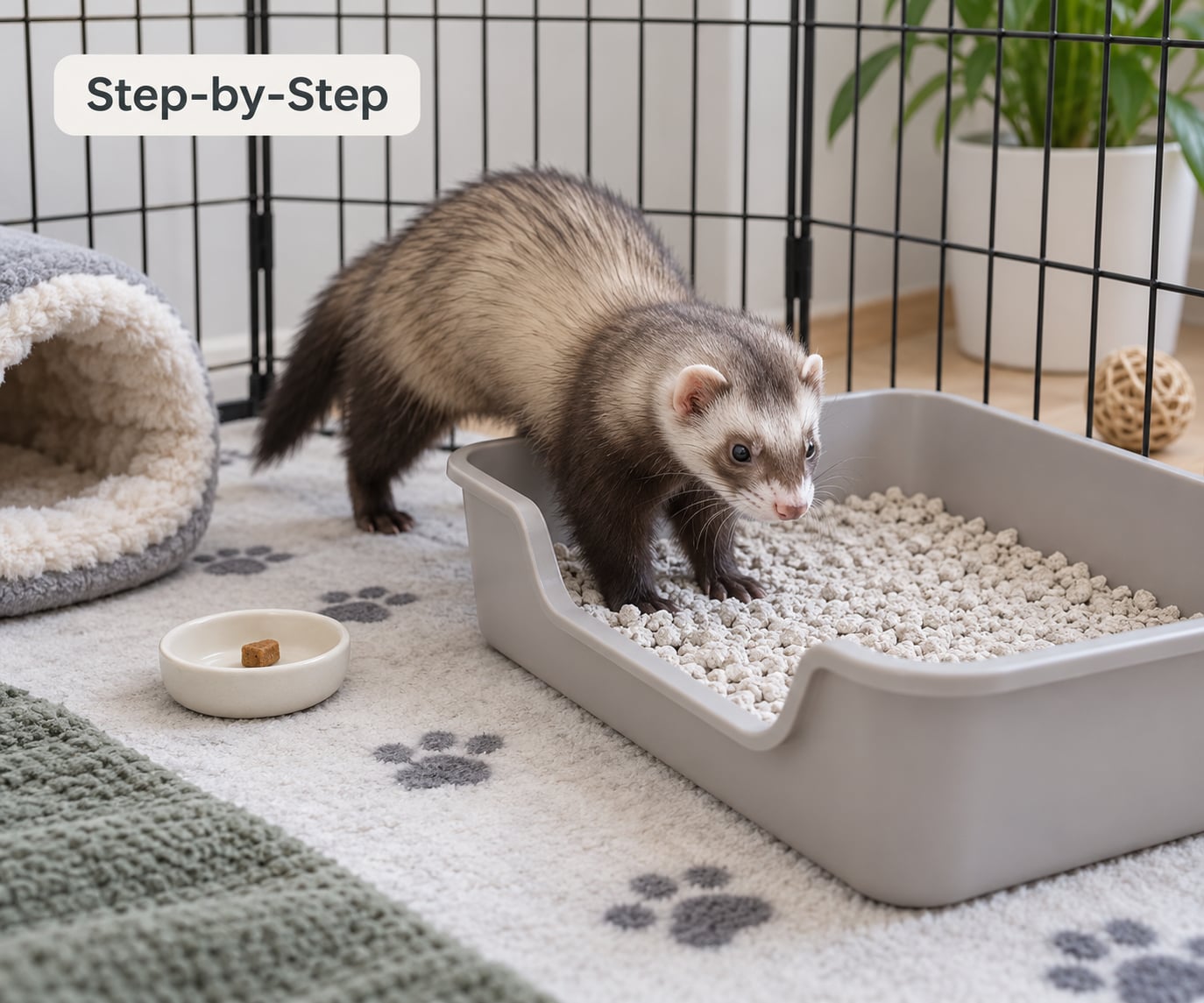
This is the step people skip, and it is the reason so many accidents continue. A tray in the corner you picked for it means nothing. Watch where the ferret actually goes for the first few days, look for a corner it visits, and put the tray right there.
Owners who let a new ferret pick its spot for a few days, then move the box to match, usually see progress much faster. Multiple boxes in every corner works too. Once the ferret shows a clear favourite, remove the extras and keep one there, because a ferret that has a choice often abandons the box entirely.
Keep the tray away from the food and water bowls. Leave enough room behind it for the animal to back in fully, and never move the tray once the habit is forming. If the box slides around under pressure, wedge it against a wall or set it on a non-slip mat.
Step 4: Reward Correct Use Immediately
Timing is everything here. The moment the ferret finishes eliminating in the correct box, say something pleased, and give a tiny treat or a piece of its normal food. Owners consistently report that a reward within a second or two teaches the connection, while a reward ten minutes later teaches nothing.
Use positive reinforcement only. Scolding, grabbing the animal mid-accident, or rubbing its nose in the mess makes the ferret fear you and, worse, learn to hide its toileting where you cannot see it. Never punish.
Catch the moments that trigger elimination. Ferrets usually go shortly after waking, after eating, and after a burst of play or digging. Put the ferret in the tray at those points, wait quietly, and reward on completion. If you catch it heading for the wrong corner, calmly scoop it up and place it in the tray before it finishes.
Step 5: Clean Accidents and Maintain the Box
Scoop the tray every day and change the litter roughly once a week. A box that smells of ammonia gets ignored, and that is a very common reason a trained ferret suddenly starts missing it.
For an accident, pick it up right away with gloves and a pet-safe enzyme cleaner, following the product’s contact time. Avoid ammonia-based or fragranced household cleaners, which can irritate respiratory tissue. Blot, don’t scrub hard, and use an enzyme product to get at what the sponge leaves behind.
Do not move the box while you clean accidents. A ferret that uses the tray, gets a reward, and then has the tray moved or replaced right after will hesitate. Leave the box exactly where it is and change only the litter inside it.
Step 6: Expand Access Slowly
Only open up more space once the animal is using the tray consistently, usually a stretch of a week or two with no accidents in the pen. Then add supervised free-roam time in a ferret-proofed room, a small safe room, or a harness and leash, and watch every session for a week before you leave a door open.
Furniture creates new corners. When accidents appear behind a sofa or in a wardrobe gap, treat that spot as a box location. Drop a tray there, or place the food and water bowls and a favourite toy in that corner so the ferret uses it for something better than the toilet.
How to tell it worked: accidents become rare rather than disappearing overnight, and the pattern stays steady even in a new room. Older ferrets with reduced mobility may need a tray with a lower lip and shallower litter so stepping in and out stays easy.
Common Mistakes
Almost every stalled litter-training problem comes down to one of these. Read the correction before you change anything, because switching boxes around frequently resets progress.
- A box that is too large. A roomy tray gives a ferret room to sit on the edge and miss. Fill it with enough litter that the surface nearly reaches the top, which stops the hovering habit.
- A box that is too far away. If the tray is not in the corner the ferret already chooses, the animal will use the corner it likes. Move the box, not the ferret.
- An entry lip that is too high. Shallow trays and low-sided boxes are the norm for a reason. A tall front edge stops a ferret from backing in properly, and owners who hit this cut a lower opening into the front of a bin report it fixes the problem immediately.
- Harsh or scented litter. Strong fragrance drives a ferret away, and dusty substrate causes respiratory irritation. Unscented paper pellets only.
- Punishing accidents. Yelling or nose-rubbing teaches avoidance and fear, and it slows everything down. Clean quietly and move on.
- Treats that are not part of the diet. A ferret on a prescribed or elimination diet should not get random table scraps as training rewards. Use something from its own food.
- Hazards left within reach. Open toilet lids, uncovered bins, electrical cords, and gaps behind appliances are the standard ferret-proofing list. Check them again every time you move furniture.
- Assuming a health problem is a training problem. A sudden change in toileting, straining, or accidents in a previously reliable ferret is a vet question, not a discipline question.
A few maintenance habits keep things steady. Check the tray daily, deep-clean the pen weekly, and wash food bowls two or three times a week. If more than one ferret shares the space, watch for one animal guarding the best box and consider a second tray in a different corner.
Frequently Asked Questions
How long does it take to litter train a ferret?
Most ferrets show reliable box use within two to four weeks, and many need closer to two months if they start with a whole-room habit to unlearn. There is no fixed deadline. Look for a steady pattern of few accidents rather than a perfect week, and keep the box in the same spot throughout.
What should I do right after an accident?
Clean it quietly with a pet-safe enzyme cleaner and never scold or rub the ferret’s nose in it. Punishment makes a ferret hide its toileting instead of stopping it. If you know the animal was about to go in the wrong place, just guide it into the tray next time and reward it there.
Is one litter box enough for a ferret?
One well-placed box works for a single ferret that already shows a preferred corner. Start with a box in every corner of the pen, then remove the extras once the animal commits to one spot. A second tray is worth adding if accidents continue or you keep two ferrets, since one may block the other’s access.
What litter is safe for ferrets?
Unscented, low-dust, non-clumping paper pellets, kept under an inch deep, are the safest choice. Avoid clay or clumping cat litter, scented varieties, silica or crystal litter, corn cob bedding, and pine or cedar shavings. Ferrets bury their faces in the substrate, so dust and any clumping material pose real respiratory and obstruction risks.
What are the signs a ferret needs a vet rather than more training?
Straining, crying while urinating, frequent small amounts of urine, blood in the urine, a hunched posture, or complete loss of appetite are all emergency signs of a possible urinary obstruction. Any sudden, lasting change in toileting habits in a previously reliable ferret also needs an examination. A blocked ferret can decline quickly.
Can a ferret be left to roam the house unsupervised?
Not until the house is thoroughly ferret-proofed, and even then close supervision is safer. Ferrets slip behind appliances, climb into laundry machines, and find small gaps that get them stuck. During training, keep the animal in a pen or small safe room with full view, and only add free-roam time in stages once box use is consistent.
Start With a Small Routine
Set the pen up with bedding, a hideout, secure bowls, and shallow trays of unscented paper pellet litter in every corner before the ferret comes home. Spend a few days watching where it chooses to go, then keep a single tray in that spot and leave it there.
Reward correct use the second it happens, scoop the tray daily, and expand the space only after a good stretch without accidents. Anything about diet, vaccination, parasites, or a sudden change in toileting goes to your veterinarian, not to a longer training schedule.